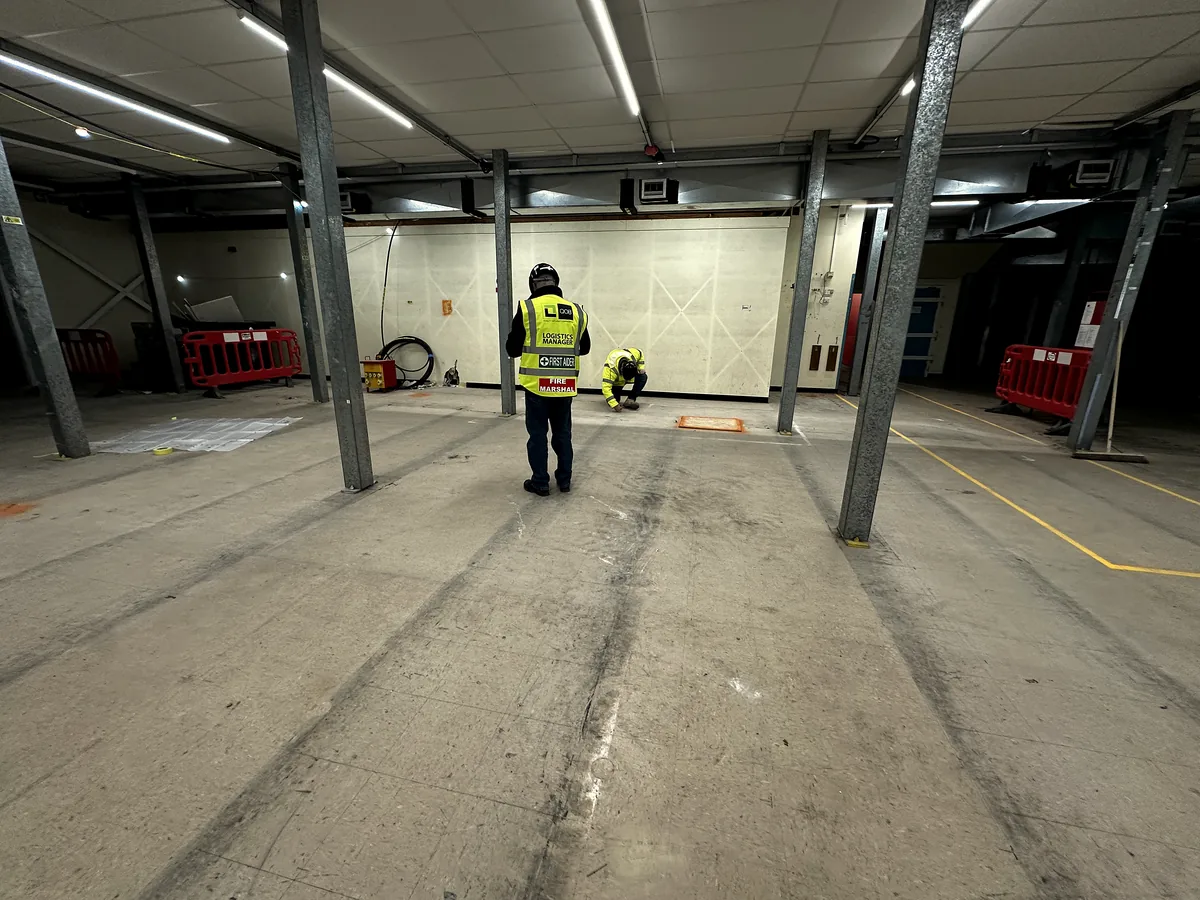
Concrete strength testing: which method answers which question
Rebound hammer, pull-out test, cores and the lab. Concrete strength testing on an existing structure is a choice between speed, cost and how defensible the number has to be. Here is how to choose.
By Terry Bagust, Co-founder and Managing Director
Concrete strength testing on an existing structure is rarely about getting one perfect number. It is about getting a number the engineer can use, at a cost in disruption the building can stand, with a method that will hold up if the result is challenged. The three methods we run most often sit at different points on that trade-off. This article explains what each one answers, where it falls short and how they are combined.
The question comes first
Before the method, be clear about what is being asked:
- Is this concrete roughly what the drawings say? A screening question. Speed and coverage matter more than precision.
- What strength can the engineer design to? An assessment question. The number goes into a calculation, so it has to be defensible and statistically sound.
- Will this fixing hold? A capacity question about an anchor or a bolt, not about the concrete in general.
- Is there a problem here, and how big is it? A diagnostic question, usually after a defect, a fire or a dispute.
Each of these points at a different test.
Rebound hammer: fast, cheap, indicative
The rebound hammer, also called the Schmidt hammer, measures surface hardness. A spring-loaded mass strikes the surface and the rebound is read off a scale. Tested to BS EN 12504-2, it gives a rebound number that correlates with strength, loosely. Surface carbonation, moisture, finish and the age of the concrete all shift the reading, so the correlation only holds when the hammer has been calibrated against cores from the same concrete.
What it answers: the screening question. Dozens of readings in an hour, no damage, a map of where the concrete is harder or softer than the rest. What it does not answer: the design question. A rebound number on its own is not a compressive strength, and an engineer who treats it as one is building on a guess.
Pull-out testing: in-situ strength, or anchor capacity
Pull-out testing covers two different jobs that share a name. One is in-situ strength estimation to BS EN 12504-3: an insert or a drilled-in anchor is pulled to failure and the force correlates with compressive strength. It is semi-destructive, leaves a small cone of damage to make good, and gives a better strength estimate than the hammer because it loads the body of the concrete, not just the skin.
The other is proof-load testing of fixings: an installed anchor is loaded to a specified proof load and its response recorded. That checks the tested anchor’s performance at that load. It does not establish its ultimate capacity, replace the anchor design, or say anything about the concrete’s strength class.
What it answers: a calibrated strength estimate without taking a core, or a fixing’s capacity. What it does not answer: the definitive strength for a formal assessment, which still needs cores.
Cores and the lab: the defensible number
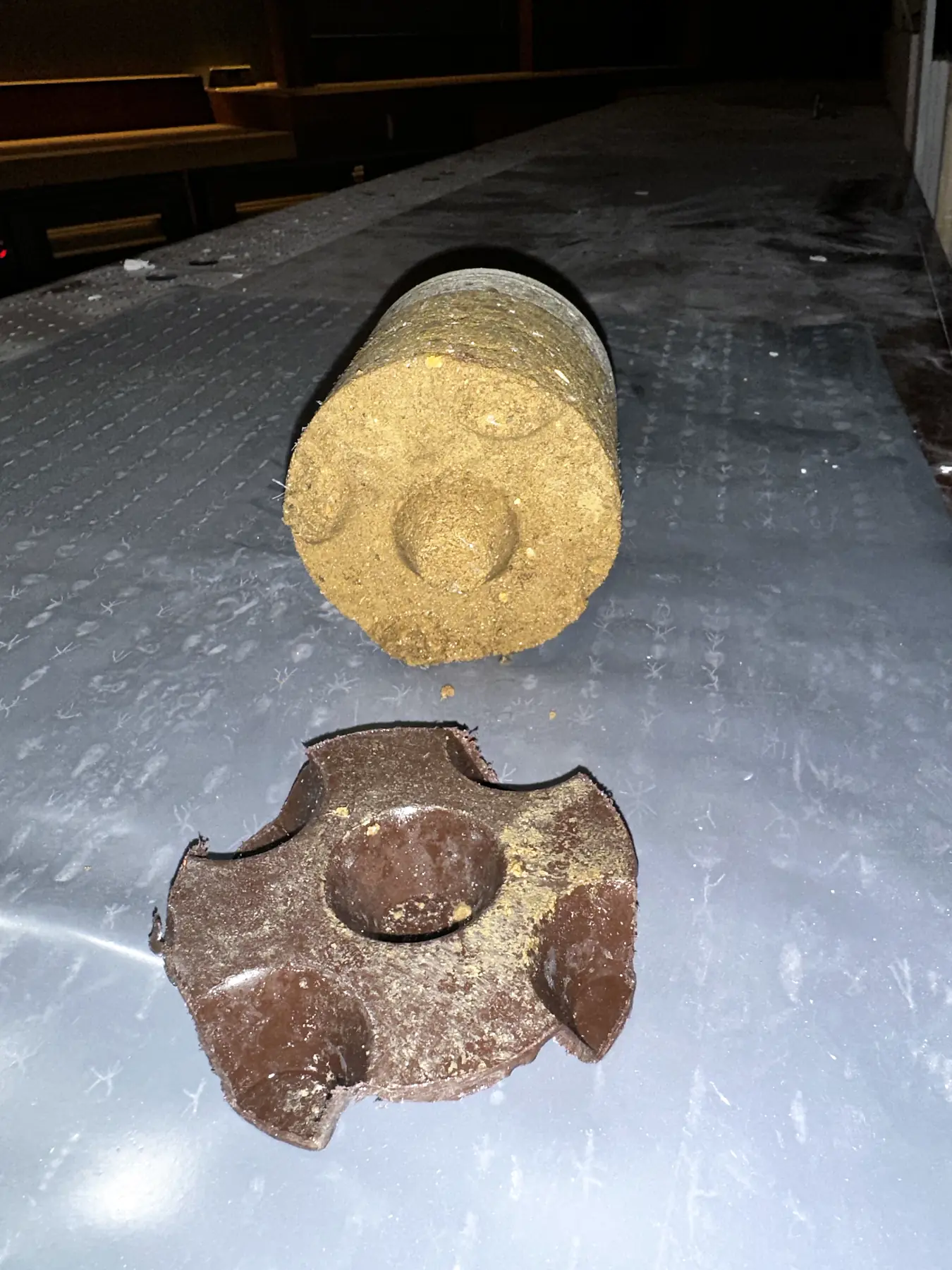
A core to BS EN 12504-1 is a cylinder cut from the structure and tested for compressive strength in the laboratory to BS EN 12390-3. Done in a UKAS-accredited lab, the certificate is the number that survives a dispute. The assessment of in-situ strength from the results follows BS EN 13791, which sets out how many cores, from where, and how the characteristic strength is derived from them.
What it answers: the design question, and the diagnostic one when the cores are also examined for carbonation depth, chloride content or the mix. What it costs: a hole in the structure per core, a lab turnaround of around a week or two, and a scan beforehand so the core barrel misses the reinforcement and the tendons.
How they are combined
The programme follows the question, and it rarely needs every method. A rebound survey across the element maps variation and picks the core positions. A small number of cores go to the lab. The hammer readings are then correlated against the core results so the map can be read as strength. Pull-out tests are used where cores are not acceptable, on a façade panel or a thin slab, and the correlation is suitable. Anchor proof tests answer the fixing brief separately.
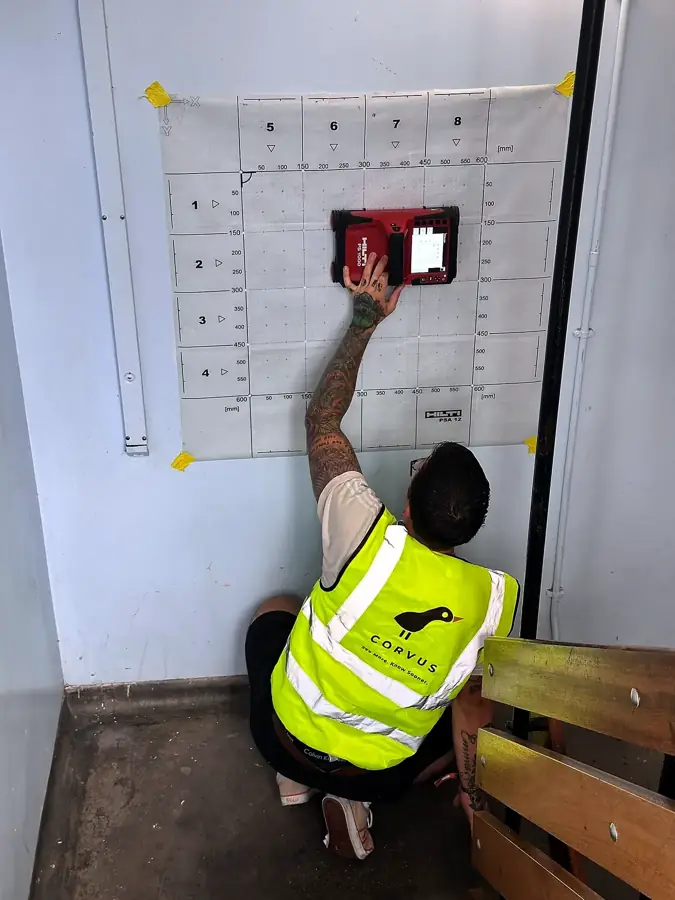
Before any core or pull-out insert goes in, the position is scanned. Reinforcement and post-tension tendons are located with GPR concrete scanning and a Ferroscan, so the intrusive test does not cause the damage it was commissioned to prevent.
Durability is a separate question
Strength testing gives the engineer material-strength evidence for the assessment of what the element can carry. Whether it will keep doing so is a durability question, and the tests are different: carbonation depth on a fresh break or a core, chloride content by depth from drilled samples sent to the lab, and a half-cell potential survey across the element to map where the reinforcement is likely to be corroding. Read against cover depth from a Ferroscan, those three show whether the carbonation front or the chlorides have reached the steel. A pull-off test is different again: it loads the tested system in tension, and failure can come in the coating or repair, at the interface, or in the concrete beneath. The result is read with the recorded failure mode. It is not a compressive strength test. See durability testing and pull-off testing.
What the report should say
A concrete strength testing report should state the method and standard for each test, the calibration used, where each reading or core was taken, the raw results, the derived strength and the limits. A rebound number without a core calibration should be labelled indicative. A characteristic strength should show how it was derived. If the report gives one confident number with none of that behind it, ask how it was reached.
For rebound hammer, pull-out testing and cores with UKAS results, see concrete testing or get a quote. Detail on each method: rebound hammer testing, pull-out tests, core sampling and compressive strength testing.