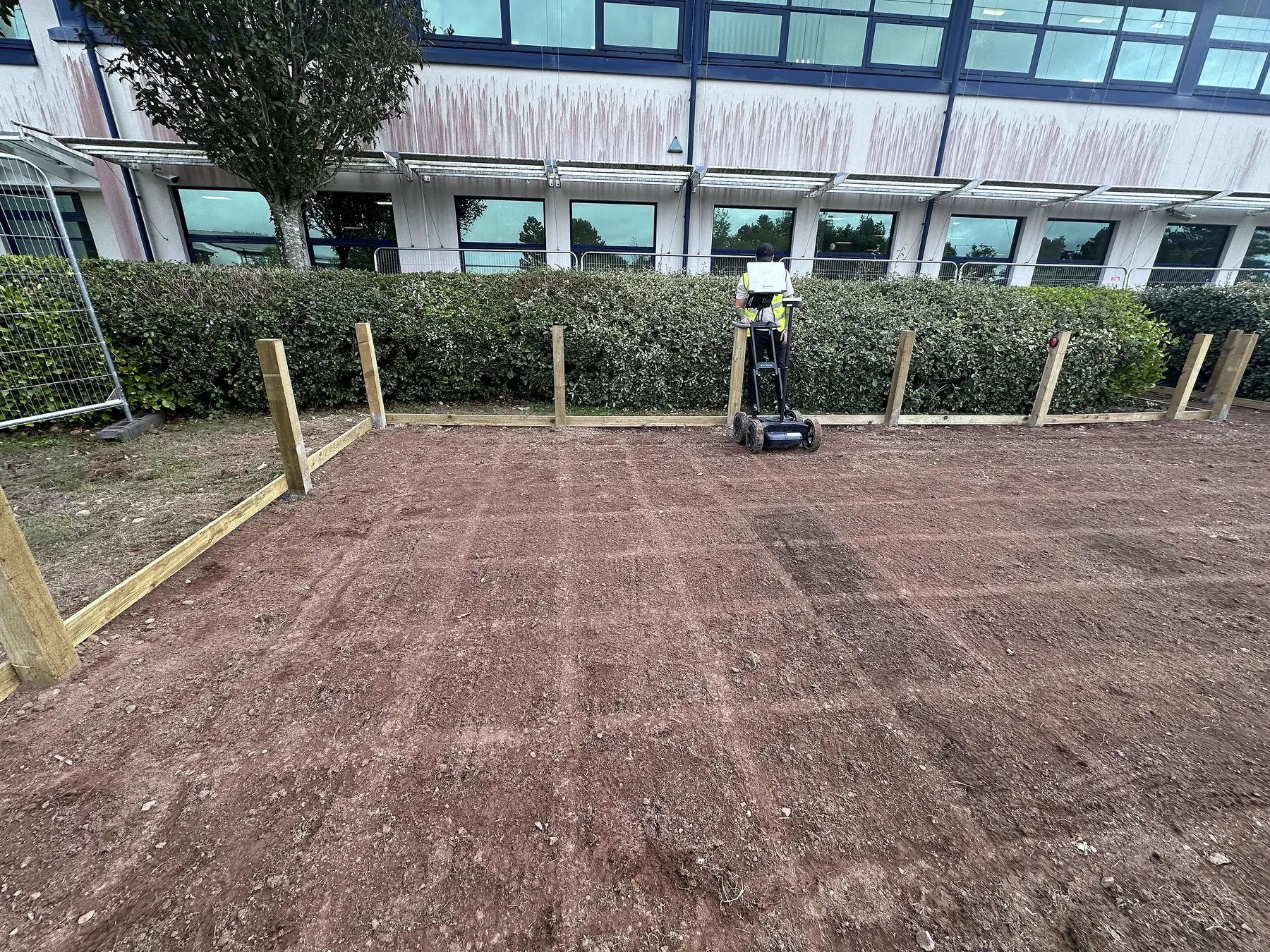
GPR Utility Survey
Why GPR is the second detection method, what it finds that a locator cannot, and where it struggles.
What the locator cannot hear.
Why GPR is the second method
An electromagnetic locator only finds what it can energise or what carries a signal. Ground-penetrating radar finds changes in the ground itself, so it is the second method that PAS 128 Type B requires. We run a Proceq GS8000, a stepped-frequency GPR from 40 to 3,440 MHz with built-in multi-band GNSS.
What it finds that a locator cannot
Plastic pipes and ducts, clay drainage, voids and chambers, and abandoned services that no longer carry a signal.
Where it struggles
Wet clay, which absorbs the signal. Made ground, which scatters it. Reinforced slabs, which mask what is beneath them. The drawing states what could not be detected as well as what was.
Why GPR alone is not PAS 128
PAS 128 Type B needs two detection methods and a full passive sweep. GPR on its own is a useful survey, but it is not a PAS 128 survey.
Who does it
Our utility surveyors hold the ProQual Level 3 Certificate in Utility Mapping and Surveying and deliver surveys to PAS 128:2022.
Where it helps
- When ground radar is needed to investigate subsurface features
- As the GPR component of a broader utility survey
What you receive
- Radar findings plotted against the surveyed coverage
- Indicative depths and unresolved anomalies identified
- Marked ground and survey photographs
- Signed Corvus report and DXF/DWG within 5 working days of the site visit
A note on interpretation. GPR-only findings are interpreted anomalies unless supported by other evidence. A GPR-only commission is not a full PAS 128 Type B survey and is not described as one.
Often surveyed together.
GPR Concrete Scanning
Ground penetrating radar scanning that finds rebar, post-tension cables, conduits and voids hidden inside concrete, before they become a problem.
Learn moreFerro Scanning
Electromagnetic scanning to map reinforcement, measure cover depth, and estimate bar diameter without touching the concrete.
Learn moreMore from PAS 128 Utility Surveys.
- PAS 128 Utility SurveysPAS 128 Explained
The British specification for finding and recording buried utilities, in plain English.
- PAS 128 Utility SurveysType B Detection Survey
A PAS 128 Type B survey: two detection methods over the whole area, every service positioned and labelled with its quality level.
- PAS 128 Utility SurveysCAT and Genny Survey
A quick electromagnetic sweep for energised cables and metallic pipes, honestly described.
Got a dig coming up?
Send the works boundary, depth of interest and available records. We call back the same working day.